
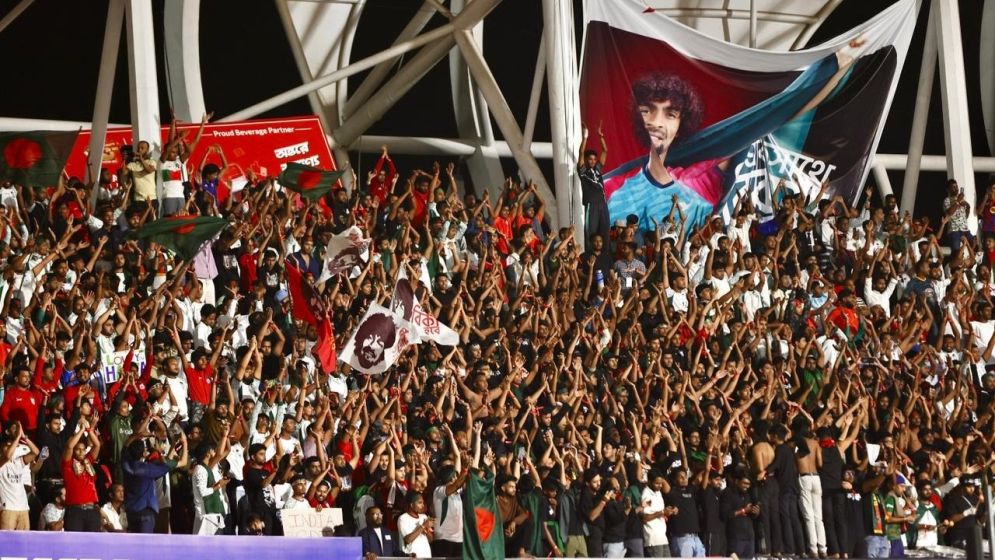
There is a peculiar madness that grips Bangladesh every four years. Long before the World Cup referee blows the first whistle, neighborhood rooftops transform into a canvas of green, yellow, sky blue, and white. Debates erupt in office corridors, and tea stalls turn into tactical war rooms. To an outsider, it is baffling. Why does a nation whose own football ranking sits near the bottom of the world charts exhibit an almost primal, unmatched obsession with a sport born thousands of miles away?
To understand this, we have to look beyond the modern pitch. Football for the Bengali people was never just a game. It was—and remains—a mirror of our nationalism, a weapon of resistance, and the very rhythm of our collective soul.
The Imperial Export and an Accidental Revolution
Modern football was born in the rigid, industrial landscape of 19th-century England. Created in 1863 by the Football Association, it was designed to teach discipline, time management, and order. As the British Empire expanded, they brought the game with them as a tool of cultural hegemony—a way to “civilize” the colonies.
By the mid-19th century, football arrived in Calcutta (now Kolkata). Back then, the city was deeply segregated. The lush fields of Fort William, elite European schools, and clubs like the Calcutta Football Club and Dalhousie Athletic Club were exclusive white enclaves. For the average Bengali, busy with traditional sports like wrestling (kustir akra), laathi khela, hadudu (kabaddi), dice, and chess, this European game was a distant, untouchable spectacle.
But traditional sports could not directly challenge British supremacy. To beat the colonizers, Bengalis had to meet them on their own turf.
The Mythic First Shot: Nagendra Prasad Sarbadhikari
The story of the first Bengali foot touching a football reads like folklore. In 1877, Hemlata Devi, a lady from the famous Sarbadhikari family, was traveling by palquin to bathe in the Ganges with her eight-year-old son, Nagendra Prasad. As they passed Fort William, little Nagendra saw British soldiers chasing a leather ball.
Fearless, the boy stepped out of the palanquin to watch. Suddenly, the ball rolled right to his feet. As the soldiers shouted, the eight-year-old dropped his hands and unleashed a powerful kick. That single shot became the historical dawn of Bengali football. Nagendra Prasad Sarbadhikari would go on to be revered as the Father of Bengali Football.
By 1878, Nagendra and his Hare School friends pooled together 30 Taka to buy a ball from a shop in Chowringhee. Amusingly, it turned out to be an oval rugby ball! The chaotic, rule-free matches played between Hindu College and Presidency College drew amused crowds. Seeing this, a British professor from Presidency College, G.A. Stack, intervened. He explained the difference between rugby and football, bought them a proper round ball the next day, and stepped onto the pitch with a whistle to referee. The beautiful game had officially integrated into Bengal.
From Pitches to Social Justice: Breaking the Caste Barrier
Nagendra Prasad did not just introduce the game; he institutionalized it. He founded the Boys Club, Friends Club, and Presidency Club. However, his crowning achievement was the Wellington Club in 1884 (later renamed Town Club), the first Indian club brave enough to pitch its tents right alongside the elite British clubs in the Maidan.
In 1887, a social crisis hit the Wellington Club. When a player from a lower-caste background was recruited, elite upper-caste members revolted. Furious at the deep-seated bigotry, the young Nagendra Prasad roared at a historic meeting:
“I shed my blood to build a club, not to curate players based on their ancestry. I will not decorate a sports arena with casteism; I will create a caste of true players.”
In protest, he dismantled his own beloved Wellington, Friends, and Presidency clubs. In 1885, within the courtyard of his in-laws’ Shobhabazar Royal Palace, he founded the famous Shobhabazar Club, throwing its doors open to everyone regardless of religion, caste, or creed. By welcoming Parsis, Christians, and Muslims, he set a rare example of secularism.
In 1892, this very Shobhabazar Club made history by defeating the British East Surrey Regiment to win the Trades Cup. Two years later, in 1894, Nagendra Prasad helped establish the Indian Football Association (IFA), the governing body of the sport in India.
The Barefoot Revolution of 1911
Following Shobhabazar’s lead, the Mohun Bagan Sporting Club was founded in North Calcutta in 1889. By 1905, they defeated the Dalhousie Club to lift the Gladstone Cup. But the ultimate, explosive moment of reckoning arrived on July 29, 1911.
Led by the legendary Shibdas Bhaduri, eleven barefoot Bengali men took the pitch in the IFA Shield final against the heavily booted, formidable British military team, the East Yorkshires Regiment.
Against all odds, the barefoot Bengalis won 2-1. It was an earth-shattering explosion that shattered the myth of white supremacy. It wasn’t just a sports victory; it was a psychological triumph for the anti-British nationalist movement. Interestingly, out of those eleven historic players, ten were sons of East Bengal (modern-day Bangladesh).
Regional Divides and the Rise of Giants
Despite their undeniable talent, players from East Bengal often faced deep regional discrimination in the Calcutta Maidan.
In 1919, during a Cooch Behar Cup match between Jorabagan and Mohun Bagan, unfair treatment toward East Bengali players sparked a rebellion. Suresh Chowdhury, alongside Tarit Bhusan Roy and Shailesh Bose, stood up for their regional pride and self-respect. In August 1920, they founded East Bengal Club.
Later, during the trauma of partition and the refugee crises, the Mohun Bagan vs. East Bengal (Ghoti vs. Bangal) rivalry ceased to be just a game. It became a living social map of survival, identity, and existence.
By the 1930s, a third superpower entered the fray: Mohammedan Sporting Club. Their golden era spanned from 1934 to 1938, during which they won the Calcutta First Division League five consecutive times, breaking the monopoly of white clubs. It was during this era that Mohammedan’s wizardly winger, Mohammed Salim, went on to play for Scotland’s famous Celtic FC, bringing glory to Indian football on European soil.
The Roots of Football in East Bengal (Bangladesh)
While Calcutta was the epicentre, East Bengal was never far behind. The cradle of football here was Dhaka College, founded in 1841. In the late 19th century, a British professor introduced his students to the game.
By 1890, the region’s first football club, Wellington Club (inspired by Calcutta’s club), was founded by engineer Ramdas Bhaduri. In 1894, this legendary club was renamed Wari Club—the original powerhouse of Dhaka football. By 1910, Wari Club defeated the powerful team of the King of Cooch Behar, earning the right to play in the IFA Shield.
In 1933, in a small tin shed at the Paltan Maidan, the Dhaka Sporting Association (DSA) was born, elevating clubs like Wari, Victoria FC, and Luxmibazar Club to new heights. In 1936, Dhaka Mohammedan Sporting Club emerged as a full-fledged chapter of the Calcutta entity, triggering an unprecedented athletic and political awakening among the Bengali Muslim community.
The Ultimate Shield: The Swadhin Bangla Football Team (1971)
The most glorious, emotional, and tear-stained chapter of our football history was written during the 1971 Liberation War.
In an achievement unique to global conflict, Bangladesh formed the world’s first-ever football team during an active war: the Swadhin Bangla Football Team. Led by Zakaria Pintoo, this team traveled across India, playing 16 exhibition matches.
Before every match, they proudly hoisted the newly minted Bangladeshi national flag and sang Amar Sonar Bangla on foreign soil, long before the country was officially recognized. They raised roughly 3.5 lakh Rupees from these matches—and donated every single paisa to the Freedom Fighters’ Liberation Fund.
The Modern Heartbeat: A Love That Refuses to Die
Following independence, the visionary leadership of Sheikh Kamal introduced modern football through Abahani Krira Chakra. The fierce Abahani-Mohammedan rivalry of the 1980s and 90s used to paralyze the nation in anticipation.
Today, it is true that our domestic football ranking has dwindled. In the roaring tide of cricket’s immense success, our local football scene often feels quiet, even neglected.
But has that primal, unadulterated love for football truly vanished from the Bengali psyche?
Absolutely not. If it had, our skylines wouldn’t be choked with the flags of Brazil, Argentina, Germany, or Portugal every World Cup. Neighbors wouldn’t measure their loyalty by whose flagpost is taller. This beautiful, irrational frenzy—unmatched anywhere else in the world—is living proof that football isn’t just a sport we watch. It is woven directly into our DNA. It is our history, our resistance, and our soul.
Reference: The Post