
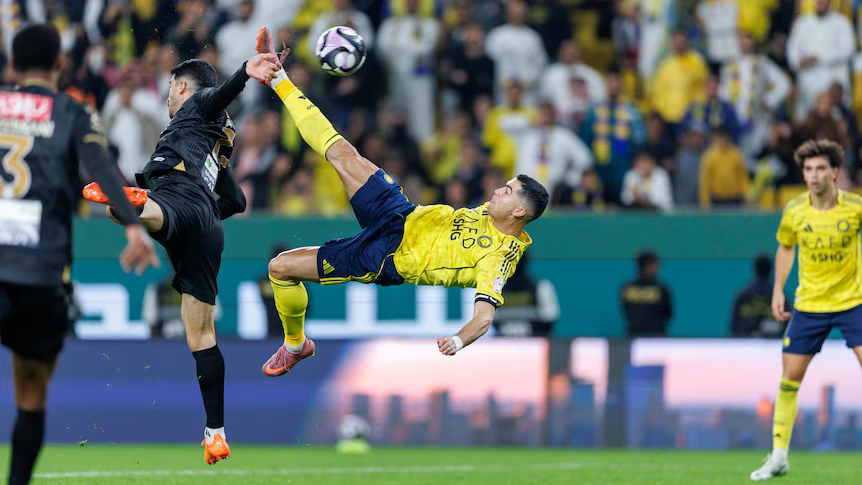
“I went to space, and the critics whispered… my feet no longer touched the ground.”
Cristiano Ronaldo read the headline again, sitting inside the gleaming observation dome of the StarVoyager-7 spacecraft. Zero gravity gently tugged at him, pulling a lock of hair upward as if the universe itself wanted to ruffle the head of the greatest footballer on Earth.
He let out a soft, amused exhale.
“My feet have never needed the ground to begin with,” he murmured.
This entire mission had started as a wild idea by the Global Sports Innovation Council: send the world’s most iconic athlete into low-Earth orbit for a special charity event, where he would attempt the first ever space goal, a symbolic shot toward Earth that would be broadcast live. Billions were waiting to watch.
But the critics… oh, they had been loud.
“He’s finished.”
“He should retire.”
“He’s desperate for attention.”
“A footballer in space? Ridiculous.”
Ronaldo had heard it all, just as he had heard countless times before—every time he scored a hat-trick, every time he defied age, every time he walked into a stadium and reminded the world he was built differently.
But as the spacecraft floated above the blue curve of Earth, those comments felt small, childish even. Below him were oceans, continents, storms swirling like slow-motion dances. Above him, infinity.
For once, even Cristiano felt tiny.
And it didn’t scare him—it humbled him.
The Mission Begins
“Ronaldo, suit check in five minutes!” Commander Aisha called from the control deck.
He nodded and pushed himself off a wall panel, drifting gracefully. His movements were naturally balanced, as if his years of mastering aerial headers had already trained him for weightlessness.
Aisha smiled. “You’re adapting fast.”
“I’ve been jumping against gravity my whole life,” Cristiano replied with a playful grin. “Today, gravity finally gave up.”
The commander laughed. “The universe is in trouble then.”
When the time came, Ronaldo suited up and drifted toward the spherical chamber built specifically for the event. Inside it was a miniature goalpost, anchored by magnetic stabilizers. Opposite it floated a smooth, silver training ball designed to behave predictably in zero gravity.
Cameras were already rolling; broadcasters had gone live. Billions waited—some cheering, some doubting, some simply curious how Ronaldo would challenge physics itself.
A technician passed by the window and gave a thumbs-up.
Cristiano inhaled deeply.
This wasn’t a stadium in Madrid, Manchester, Turin, Riyadh, or Lisbon.
This was the boundless void.
And he wasn’t just playing for a club—he was playing for humanity’s imagination.
The Cosmic Shot
“Three… two… one… Begin!”
The chamber lights dimmed, focusing on him. The Earth glowed outside the window like a massive blue stadium floodlight. Cristiano pushed gently off the starting bracket, drifting toward the ball.
In zero gravity, the smallest push mattered. Too strong and he’d spin uncontrollably. Too weak and he’d drift without momentum. But Ronaldo’s body, trained by decades of precision and control, knew instinct from memory.
He approached the ball, twisting slightly mid-air. Every movement felt like slow motion, like dancing in honey. His eyes locked onto the silver sphere. For a moment, he wasn’t in space—he was 18 again in Sporting Lisbon, 25 in Manchester, 30 in Madrid… time collapsed.
He struck.
The ball glided, almost silently, following a perfect trajectory—a cosmic version of his famous knuckleball free-kick. It curved slightly, stabilized by the special design, and drifted straight into the goal.
A golden flash lit up the chamber.
The universe’s first space goal.
The technicians cheered. The commander clapped. The livestream exploded with numbers.
And Cristiano floated there, arms open wide, unleashing his trademark “Siuuuuuu!” in a gravityless roar.
His voice echoed strangely—muted yet powerful, swallowed partly by the chamber walls. But the energy? Timeless.
The Critics Strike Again
Within minutes, global networks had begun replaying the shot. Social media erupted, memes and celebrations flooding every feed imaginable.
Yet, predictably, a certain group also reappeared.
“Fake.”
“He only did it for attention.”
“He’s literally floating. How is that impressive?”
“He left Earth because he’s irrelevant.”
Cristiano found their comments flashing on one of the holographic monitors. Aisha, noticing, raised an eyebrow.
“You shouldn’t look at those while in orbit,” she advised softly.
He shrugged. “I don’t mind.”
But she could see a quiet storm in his eyes—one she recognized as motivation, not sadness.
“Do you know what my grandmother used to say?” Aisha offered. “When you climb too high, people shout from below. Not because they want to reach you… but because they want you to come down to where they are.”
Ronaldo smiled slowly. “Then I suppose I have to keep climbing.”
The Second Attempt — A Message to the World
Later that day, as Earth rotated beneath them like a living marble, Cristiano requested another session with the camera crew.
“This time, no goalpost,” he declared. “Just me, the ball, and the universe.”
The team agreed.
He floated in the center of the chamber again, holding the silver ball gently. The Earth glowed like a soft lantern behind him. When the director gave the cue, Cristiano spoke.
“When I was a boy in Madeira,” he began, “people said I dreamed too big. When I played my first professional match, people said I wasn’t ready. When I won my first Ballon d’Or… they said it was luck. And now? They say my feet have no ground beneath them.”
He paused, letting the silence stretch like a cosmic horizon.
“But that’s the thing… to fly, you can’t cling to the ground.”
Another pause. The world watched breathlessly.
“I came to space not to prove I can score without gravity. I came to show that dreams—no matter how crazy—belong to everyone.”
Then he kicked the ball softly. It drifted upward, spinning gently into the void of the chamber like a tiny planet finding its orbit.
“You don’t need the ground under your feet,” Cristiano concluded. “You need the courage to lift off.”
Aisha, watching from the console, felt a quiet warmth spread through her chest. This wasn’t the speech of an athlete desperate for relevance. This was a man who had carried expectation, pressure, and criticism his entire life—and turned them into fuel.
Touchdown
When the spacecraft finally returned to Earth, the landing site was flooded with lights, reporters, fans, and banners. Children wore astronaut helmets painted with CR7 logos. Old fans cried. Young athletes held up posters reading:
“Dream beyond gravity.”
As Cristiano stepped onto solid ground again, a journalist shouted:
“How does it feel to have the world saying you’ve lost touch with reality?”
He smiled gently, the kind of smile only someone who has lived beyond the ordinary could give.
“I went to space,” he replied, “and they claimed my feet had no ground under them. But I found something better.”
“And what’s that?” the reporter asked.
Cristiano looked up at the sky—at the vast darkness where he had floated freely—and whispered:
“Freedom.”
Writer: Amitab Deb Nath