
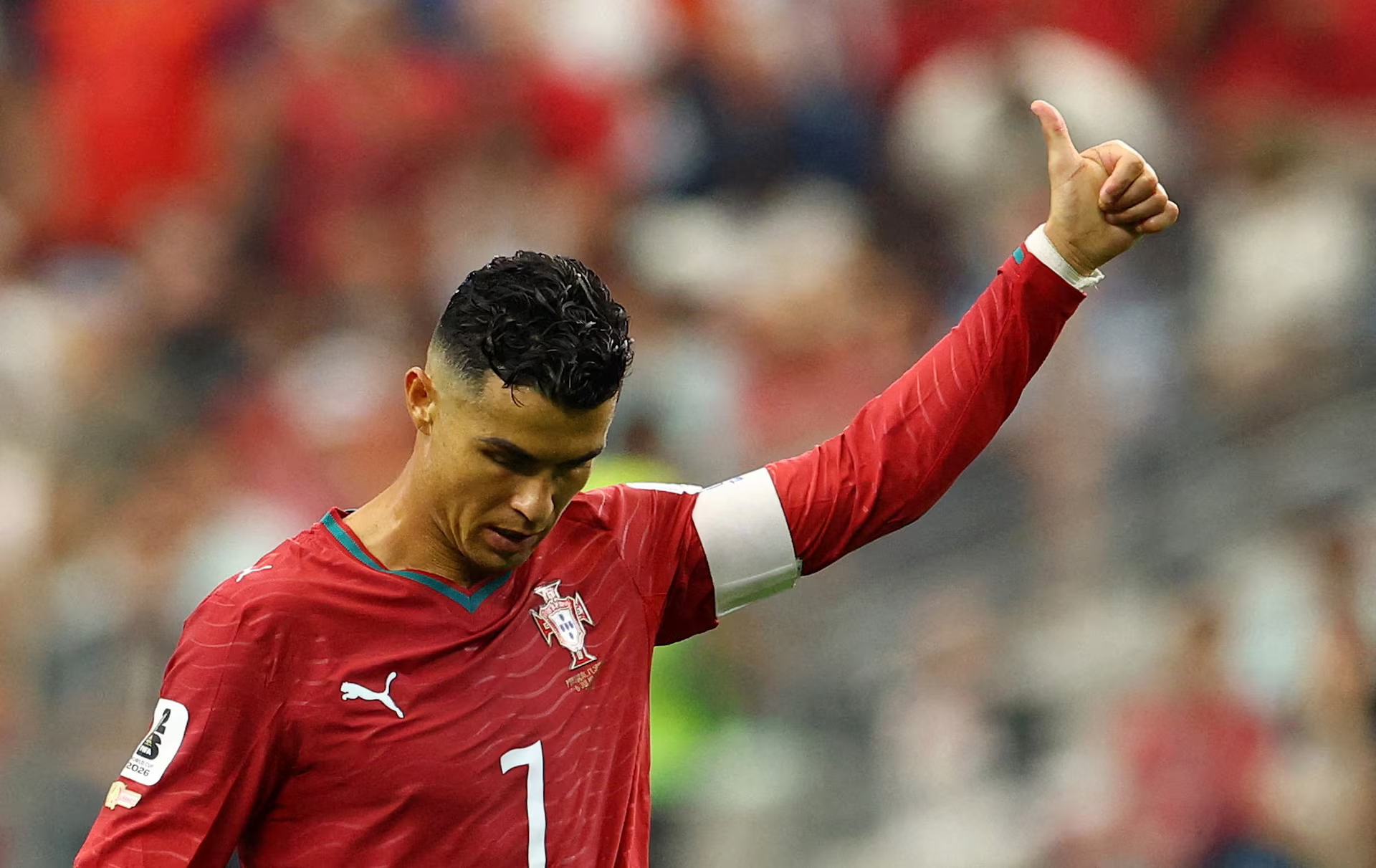
I could begin by talking about a difficult childhood. I could describe poverty, an alcoholic father, the uncertainty that surrounded his family, the emotional weight of growing up too quickly, and the responsibilities that arrived long before they should have. I could point to the countless obstacles that shaped Cristiano Ronaldo’s early years and explain how those experiences might have influenced the person he would later become.
I could also approach his story through psychology. I could discuss risk factors, resilience, the psychology of elite performance, the relentless pursuit of excellence, perfectionism, self-discipline, delayed gratification, and the extraordinary standards he set for himself. It would be easy to organise his life into psychological theories and create a neat explanation for his success. On paper, everything could seem logical and predictable.
But perhaps something even more interesting is happening here.
In recent years, we have become increasingly comfortable turning personality traits into diagnoses and life stories into simple explanations. We often search for one defining event that explains everything about a person. We hear about someone’s childhood and immediately believe we understand who they are. We discover a hardship, and we assume it fully explains every achievement that follows.
It is comforting to believe that people’s lives follow straight lines.
Yet human beings rarely work that way.
Cristiano Ronaldo was born into circumstances that could have produced an entirely different ending. There was no guarantee that he would become one of the greatest athletes in history. In fact, there were many reasons to believe he never would.
His family struggled financially. His father battled alcoholism. Opportunities were limited. Like millions of children around the world, he grew up in an environment where dreams often disappear beneath the weight of everyday survival.
One of the most moving parts of his story is something many people learned during the World Cup. His mother, facing overwhelming poverty and uncertainty, once considered not continuing her pregnancy. It was never a reflection of a lack of love. It was a heartbreaking consequence of fear, economic hardship, and the impossible choices that many families are forced to confront.
That fact has stayed with me because it says something much larger than football.
It reminds us how many stories never get the opportunity to begin at all.
It reminds us that history is filled with lives that could have transformed the world if only circumstances had been different.
And it reminds us that sometimes the most extraordinary journeys begin in places where hope seems least likely to survive.
None of this means that suffering should be romanticised.
Pain is not a magical teacher.
Poverty is not a secret path to greatness.
Trauma does not automatically produce strength.
For every person who overcomes immense hardship, there are countless others whose dreams are limited by circumstances beyond their control. Their stories deserve the same compassion and respect.
What deserves admiration is not suffering itself.
What deserves admiration is the remarkable human ability to choose, adapt, persist, and grow despite suffering.
Cristiano Ronaldo’s achievements were never guaranteed by his childhood. They were shaped by thousands of choices made over decades: waking up early, training longer than everyone else, accepting criticism, improving weaknesses, sacrificing comfort, recovering from failure, and refusing to believe that his circumstances had already decided his future.
Talent played a role.
Opportunity played a role.
Support from coaches, teammates, family members, and mentors played a role.
But none of these factors alone can explain the life he built.
Perhaps that is why his story resonates with millions of people across different cultures, languages, and generations.
People do not admire Cristiano Ronaldo simply because he scores goals.
They admire him because he represents possibility.
He reminds us that our beginnings matter, but they do not always determine our endings.
He reminds us that predictions are not destinies.
He reminds us that labels are often too small to contain the complexity of a human life.
Every individual carries within them possibilities that cannot be measured entirely by childhood experiences, psychological theories, statistics, or social expectations.
A person’s first chapter is important, but it is never the whole book.
That is why Cristiano Ronaldo’s story is about much more than football.
It is about hope without illusion.
It is about discipline without excuses.
It is about ambition without forgetting where you came from.
Most importantly, it is a reminder that human beings are always capable of becoming more than the predictions others make about them.
That, more than the goals, the records, or the trophies, is why so many people continue to admire CR7.
Because his greatest achievement may not be proving that he became one of football’s greatest players.
It may be proving that no one else’s expectations have the final word on what a human being can become.