
If football were a religion, then the holiest pilgrimage site would be the Santiago Bernabéu. Every blade of grass there carries the echoes of battle, and every whisper of wind roars with one immortal chant — “Hala Madrid!”
This is not merely a white jersey. It is royalty woven into fabric. The football world has many clubs that win trophies, but only one club truly rules history — Real Madrid.
On March 6, 1902, when Madrid Football Club began its journey, nobody could have imagined that it would become the greatest symbol of glory and dominance in football history. “Madridismo” is not just a word; it is a philosophy — a belief that teaches its followers that second place is another form of failure.
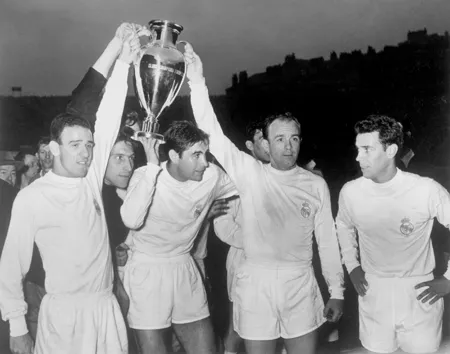
After the devastation of war, Santiago Bernabéu rebuilt the club from ruins and transformed it into a global institution. Then came the golden 1950s. Alfredo Di Stéfano, Ferenc Puskás, Francisco Gento, and Raymond Kopa turned football into poetry. Together, they conquered Europe with five consecutive European Cups – an achievement that still stands as one of the sport’s most untouchable legacies. From that era onward, Europe’s crown seemed permanently reserved for Madrid.
The decades that followed brought both triumph and suffering. During the 1980s, the legendary “Quinta del Buitre” dazzled Spain with breathtaking football, yet Europe continued to slip away. For thirty-two long years, Real Madrid fans waited for the return of continental glory.
Finally, in 1998, destiny arrived in Amsterdam. A single strike from Predrag Mijatović ended decades of pain and delivered “La Séptima” — the club’s long-awaited seventh European crown.
Then came the Galácticos era under Florentino Pérez. Football had never seen anything like it. Zinedine Zidane, Luís Figo, Ronaldo Nazário, David Beckham, and club icon Raúl González formed a team that looked more like mythology than reality. In Glasgow, Zidane’s unforgettable volley became immortal — a moment forever carved into football history.
Then, in 2009, Cristiano Ronaldo arrived at the Santiago Bernabéu, and a new era began. While FC Barcelona were dominating world football, Real Madrid stood as their fiercest rival. José Mourinho restored the club’s warrior mentality, while Carlo Ancelotti brought calmness, balance, and belief.
And then came the night that defined immortality.
Lisbon, 2014. The clock showed 90 minutes. Defeat stood inches away. But Real Madrid does not believe in endings. In stoppage time, Sergio Ramos rose into the sky and scored the header that changed history forever. That goal was not just a goal – it was resurrection. “La Décima” was finally won.
What followed felt almost unreal. Under Zinedine Zidane, Real Madrid achieved the impossible: three consecutive UEFA Champions League titles in the modern era. At that moment, Football understood something eternal — the Champions League is not just a tournament; it is Real Madrid’s kingdom.
Legends have departed. Cristiano Ronaldo left. Sergio Ramos left. Karim Benzema left. Yet the power of the white shirt has never faded. New stars like Vinícius Júnior, Rodrygo, and Jude Bellingham now carry the torch of greatness.
The miraculous Champions League run of 2022 against Paris Saint-Germain, Chelsea FC, and Manchester City FC shocked the football world once again. Because Real Madrid never accepts defeat. They survive. They rise. They conquer.
Because Real Madrid is more than a football club.
It is an unbreakable spirit.
It is the emotion of a father gifting his child their very first white jersey.
It is the tear in a supporter’s eye after defeat — and the hope that brings them back again.
Kings may stumble from time to time,
but empires never fall.
“Hala Madrid!”